

AV Commissioning Checklist for System Integrators
Modern businesses rely heavily on audiovisual technology to support communication, presentations, and collaboration. From conference rooms and training spaces to command centers and digital signage environments, reliable AV systems are essential for daily operations.
However, installing AV equipment is only the first step. Without proper AV Commissioning, organizations often experience issues such as poor audio quality, display failures, or network connectivity problems.
A structured step-by-step AV commissioning checklist helps system integrators verify every component, validate system performance, and ensure that the entire AV environment works flawlessly before project handover.
This guide explains the AV commissioning process, key strategies, common challenges, and best practices to help AV professionals deliver reliable and high-performing audiovisual systems.
What is AV Commissioning?
AV Commissioning is the process of testing, verifying, and validating audiovisual systems after installation to ensure they operate according to design specifications.
During commissioning, integrators confirm that:
- AV devices are installed correctly
- Audio and video signals function properly
- Control systems operate reliably
- Networked AV devices communicate effectively
- End users can operate the system easily
A well-defined AV system testing checklist ensures that all technical components are properly verified before deployment.
For system integrators, this process reduces errors and ensures successful project delivery.
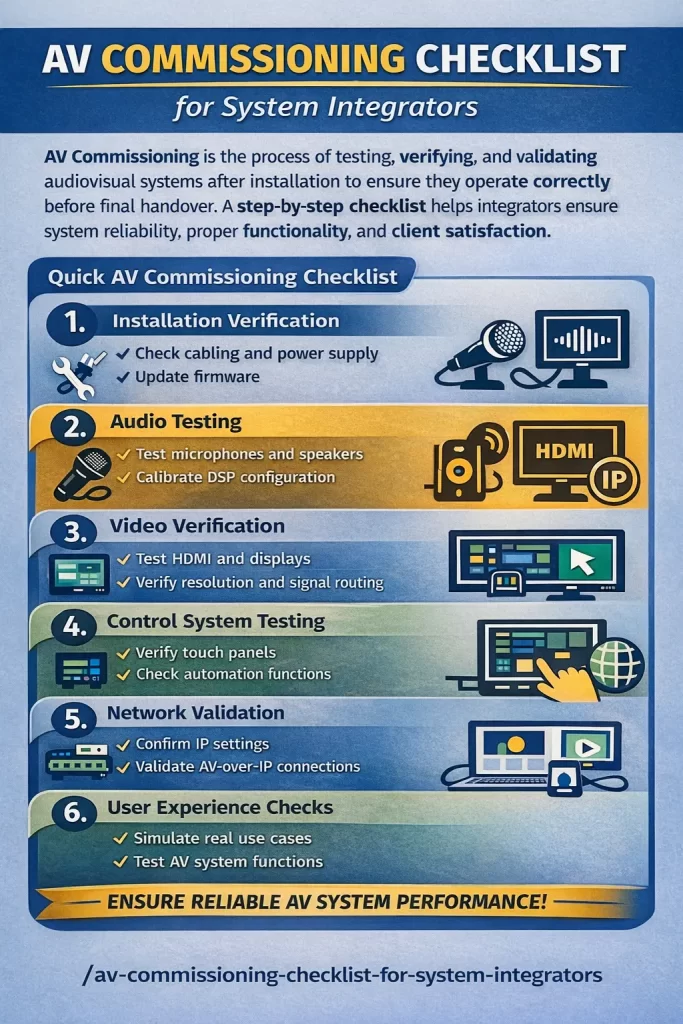
Step-by-Step AV Commissioning Checklist
Below is a simplified AV commissioning workflow used by professional system integrators.
| AV Commissioning Step | Key Tasks |
| Installation Verification | Check cabling, power connections, firmware updates |
| Audio Testing | Test microphones, speakers, and DSP configuration |
| Video Verification | Validate HDMI signals, displays, and resolution |
| Control System Testing | Test touch panels and automation functions |
| Network Validation | Verify IP settings and bandwidth usage |
This AV installation verification checklist ensures that all technical aspects of the system are validated before client handover.
Why AV Commissioning Matters for Businesses
Organizations invest significant resources into AV infrastructure, but without proper commissioning, systems may fail during important meetings or presentations.
Proper AV Commissioning ensures that AV systems perform reliably from day one.
Key reasons commissioning matters include:
- Detects configuration errors before deployment
- Improves audio and video performance
- Ensures proper integration between AV devices
- Reduces post-installation troubleshooting
- Provides documentation for system validation
For enterprises and commercial facilities, commissioning is essential to ensure technology investments deliver real value.
Why AV Commissioning Is Critical
Industry reports indicate that over 35% of AV system issues occur due to configuration errors discovered after installation.
These problems often result from incomplete testing during the deployment phase.
Without a proper commercial AV commissioning process, organizations may experience:
- System downtime during meetings
- Poor audio performance
- Display switching issues
- Network connectivity failures
By following a structured AV integrator commissioning workflow, integrators can identify and resolve issues before the system goes live.
This proactive approach significantly improves system reliability and user satisfaction.
Best Practices for AV Commissioning
Successful commissioning requires a structured approach and attention to detail.
Below are key best practices used by professional system integrators.
1. Verify Installation Before Testing
Before starting AV Commissioning, confirm that the installation phase is complete.
Verify:
- Equipment mounting and rack installation
- Signal cable connections
- Network configuration
- Device firmware versions
Completing this AV installation verification checklist ensures that the system is ready for testing.
2. Perform Comprehensive Audio Testing
Audio performance is one of the most important aspects of an AV environment.
During AV system testing, integrators should verify:
- Microphone inputs
- Speaker outputs
- DSP processing
- Audio signal routing
- Echo cancellation and audio levels
Proper calibration ensures clear communication in meeting rooms and collaboration spaces.
3. Validate Video Signal Routing
Video testing confirms that all displays and switching systems function correctly.
Key verification tasks include:
- Testing HDMI connections
- Checking AV-over-IP video streams
- Verifying display resolution
- Testing video switching between sources
This step ensures seamless presentations and video conferencing experiences.
4. Test Control System Functionality
Modern AV environments rely on centralized control systems that allow users to manage multiple devices through a single interface.
Control system testing should verify:
- Touch panel responsiveness
- Automation scripts
- Device communication
- User interface navigation
A properly tested control interface ensures that users can operate the system easily.
5. Validate Network Infrastructure
Many modern AV environments operate on IP-based networks.
Network validation includes:
- Verifying IP address configuration
- Testing network bandwidth
- Checking AV-over-IP streaming performance
- Confirming VLAN configuration
A stable network infrastructure is essential for modern AV deployments.
Benefits of AV Commissioning for Businesses
Organizations that prioritize AV Commissioning gain several advantages.
Reliable System Performance
Well-tested systems operate consistently and reduce technical disruptions.
Improved Collaboration
Clear audio and reliable video improve meeting experiences.
Reduced Maintenance Costs
Early detection of configuration issues prevents costly repairs later.
Faster Troubleshooting
Commissioning documentation helps support teams diagnose issues quickly.
Higher ROI on AV Investments
Businesses gain the full value of their AV infrastructure when systems operate efficiently.
Common AV Commissioning Challenges
Even experienced system integrators may face challenges during the commissioning process.
Network Configuration Errors
Incorrect network settings can prevent AV devices from communicating.
Solution:
Collaborate with IT teams and validate network configuration early.
Audio Calibration Problems
Poor DSP tuning can cause uneven sound distribution.
Solution:
Use professional calibration tools during the AV system testing checklist phase.
Device Integration Issues
Equipment from different manufacturers may require additional configuration.
Solution:
Verify compatibility and update firmware before commissioning.
Future Trends in AV Commissioning
The AV industry continues to evolve as new technologies emerge.
Future commissioning processes will likely include:
AI-Based System Diagnostics
Artificial intelligence may automatically detect system performance issues.
Remote AV Monitoring
Cloud-based platforms allow integrators to monitor system health remotely.
AV-over-IP Expansion
More AV environments are transitioning to network-based infrastructure.
Automated Commissioning Tools
Future tools may automate parts of the commercial AV commissioning process, making testing faster and more accurate.
System integrators who adopt these technologies will gain a competitive advantage.
Conclusion
Installing AV equipment is only part of a successful AV project. Ensuring that every component functions correctly is what truly determines system performance.
AV Commissioning provides the final verification that confirms audio performance, video quality, network connectivity, and control system functionality.
By following a structured step-by-step AV commissioning checklist, system integrators can identify configuration issues early and deliver reliable AV systems to their clients.
For businesses, this means fewer technical problems, smoother collaboration, and greater confidence in their AV technology investments.
As AV systems become more complex and network-driven, professional commissioning will remain a critical step in successful system integration.
FAQ
What is an AV commissioning checklist?
An AV commissioning checklist is a structured process used by system integrators to test and verify audiovisual systems before deployment.
Why is AV commissioning important?
It ensures system reliability, improves audio and video performance, and prevents technical issues after installation.
When should AV commissioning be performed?
AV commissioning should take place after installation but before the final system handover to the client.