

Author name: admin

Best Practices for Crestron Programming in Commercial AV Systems
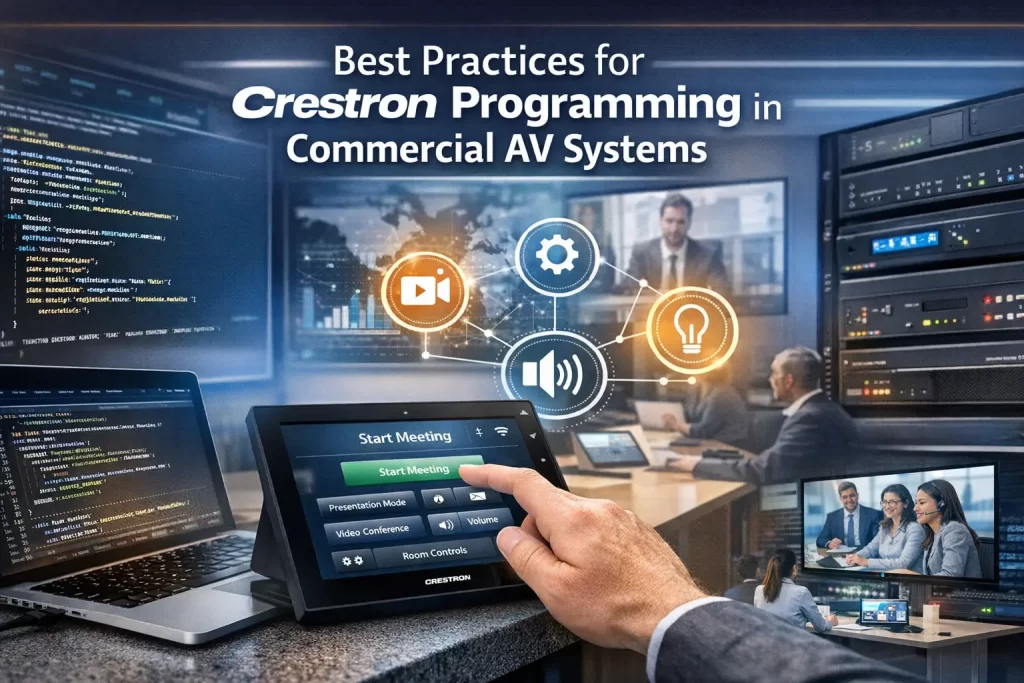
Crestron programming interface controlling commercial AV systems in a smart meeting room with touch panel automation and video conferencing setup

Modern workplaces rely heavily on technology for communication and collaboration. From boardrooms to training centers, businesses depend on advanced commercial audiovisual systems to conduct meetings, presentations, and hybrid conferences.

However, installing AV hardware alone does not guarantee a smooth experience. Many organizations struggle with complex controls, integration issues, and unreliable system performance. This is where Crestron Programming for Commercial AV becomes essential.

Automation platforms like Crestron allow multiple devices—displays, microphones, cameras, and lighting systems—to work together through a centralized control system. When implemented correctly, these solutions simplify operations, improve user experience, and increase workplace productivity.

This guide explains the best practices for Crestron programming in commercial AV systems, helping businesses, AV integrators, and IT teams design efficient and scalable automation environments.

What is Crestron Programming?

Crestron Programming for Commercial AV is the process of configuring automation software that enables audiovisual devices to communicate and operate through a centralized control system. It allows organizations to manage displays, audio equipment, lighting, and conferencing tools from a single interface.

Automation systems powered by Crestron are widely used in corporate offices, universities, and government facilities to streamline AV control systems and improve meeting room efficiency.

Why Crestron Programming Matters in Commercial AV

As workplaces become more digital, the demand for reliable commercial AV automation is increasing. Companies frequently use collaboration platforms like:

  • Microsoft Teams
  • Zoom

Without proper programming and AV system design and integration, devices from different manufacturers may fail to work together efficiently.

Professional Crestron system integration ensures that:

  • Devices communicate smoothly
  • Meeting rooms start with one touch
  • Audio and video synchronization works correctly
  • IT teams can manage systems centrally

This makes smart meeting room technology easier to operate for employees and visitors.

Key Best Practices for Crestron Programming

1. Prioritize User-Friendly Interface Design

A well-designed interface is critical for any Crestron touch panel programming project.

Users should be able to start meetings, control devices, and adjust settings with minimal effort.

Best practices include:

  • Large, clearly labeled buttons
  • One-touch meeting launch
  • Simple navigation menus
  • Logical grouping of controls

This approach improves the usability of enterprise AV systems.

2. Use Modular Programming Architecture

Experienced developers rely on modular programming when building Crestron automation solutions.

This approach divides the system into reusable modules such as:

  • Display control module
  • Audio control module
  • Lighting control module
  • Video conferencing module

Benefits of modular architecture include:

  1. Faster troubleshooting
  2. Easier system upgrades
  3. Simplified maintenance
  4. Greater scalability

3. Optimize System Performance

Efficient Crestron control system programming ensures fast response times and reliable automation.

Optimization techniques include:

  • Reducing unnecessary logic loops
  • Minimizing network traffic
  • Managing processor loads
  • Streamlining device communication

Proper optimization is essential for large commercial audiovisual systems that control multiple devices simultaneously.

4. Implement Scalable AV System Design

Modern offices expand quickly, so AV system design and integration must support future growth.

Scalable systems allow organizations to:

  • Add new meeting rooms
  • Integrate new devices
  • Upgrade collaboration tools
  • Expand enterprise AV networks

Using scalable Crestron automation solutions ensures long-term reliability.

5. Ensure Seamless Integration with Collaboration Platforms

Meeting rooms often depend on conferencing software such as:

  • Zoom
  • Microsoft Teams

Proper programming ensures that users can:

  • Start meetings instantly
  • Share presentations
  • Control cameras and microphones
  • Switch between conferencing platforms

This level of commercial AV automation improves collaboration in hybrid workplaces.

Real-World Use Cases

Corporate Meeting Rooms

Large corporations implement Crestron system integration to manage meeting rooms across multiple floors.

Benefits include:

  • Centralized AV control
  • One-touch meeting launch
  • Automated lighting and display control

Universities and Training Centers

Educational institutions use AV control systems for lecture halls and hybrid classrooms.

Automation allows instructors to easily control:

  • Projectors
  • Microphones
  • Recording systems
  • Video conferencing tools

Conference and Event Spaces

Event venues rely on Crestron Programming for Commercial AV to manage large audiovisual setups including LED displays, audio processors, and live streaming equipment.

Benefits of Professional Crestron Programming

Organizations investing in professional Crestron control system programming gain several advantages.

Improved System Reliability

Proper programming reduces system failures and improves stability.

Simplified Technology Management

IT teams can manage multiple devices from a single control platform.

Increased Productivity

Employees spend less time troubleshooting AV issues.

Scalable AV Infrastructure

Businesses can expand their enterprise AV systems without redesigning the entire setup.

Common Crestron Programming Mistakes

Even experienced developers sometimes face challenges in commercial AV automation projects.

Overcomplicated Interfaces

Complex control panels confuse users and slow down meetings.

Solution:
Use simple, intuitive layouts.

Poor Device Integration

Different hardware components may fail to communicate properly.

Solution:
Follow standardized integration protocols.

Lack of Documentation

Without proper documentation, future maintenance becomes difficult.

Solution:
Maintain clear programming documentation and system diagrams.

Future Trends in Commercial AV Automation

The AV industry continues to evolve as new technologies transform workplaces.

Key trends shaping the future include:

AI-Driven AV Systems

Artificial intelligence is improving device automation and system diagnostics.

Cloud-Based AV Management

Cloud platforms enable remote monitoring and management of AV systems.

Smart Meeting Room Analytics

Organizations are using data analytics to optimize meeting room utilization.

Companies adopting advanced Crestron automation solutions will benefit from these innovations as workplace technology evolves.

Conclusion

As organizations adopt hybrid work models, reliable audiovisual infrastructure has become essential. Effective Crestron Programming for Commercial AV ensures that meeting rooms, training spaces, and conference facilities operate smoothly.

By focusing on user-friendly interfaces, modular programming, performance optimization, and scalable system design, businesses can build reliable and efficient AV environments.

Companies that invest in professional Crestron system integration and advanced commercial AV automation solutions will create smarter workplaces that support productivity, collaboration, and innovation.

FAQs

1. What is Crestron programming used for?

Crestron programming enables centralized control of AV devices such as displays, audio systems, cameras, and lighting. It simplifies automation and improves usability in commercial environments.

2. Why are Crestron systems popular in commercial AV?

Crestron systems are widely used because they offer reliable automation, scalable infrastructure, and seamless integration with modern collaboration platforms.

3. What industries use Crestron AV automation?

Industries using Crestron automation solutions include corporate offices, universities, hospitals, government buildings, and conference centers.

4. How does Crestron improve meeting room technology?

Crestron systems automate device control, simplify meeting room setup, and integrate with collaboration platforms like Zoom and Microsoft Teams.

5. What skills are needed for Crestron programming?

Developers typically need knowledge of AV networking, automation scripting, system integration, and AV control systems design.

Best Practices for Crestron Programming in Commercial AV Systems Read More »
The Future of Audio Visual Technology in Business

In today’s fast-changing digital workplace, businesses rely heavily on audio visual (AV) technology to improve communication, collaboration, and productivity. From smart meeting rooms to AI-powered conferencing systems, AV technology is transforming how organizations operate. As companies continue to adopt hybrid work models and global collaboration, the future of AV technology is becoming more innovative, integrated, and intelligent.

In this blog, we explore the future of audio visual technology in business and how organizations can benefit from adopting modern AV solutions.

The Growing Importance of AV Technology in Business

Modern workplaces depend on seamless communication. Whether teams are working from the office, home, or different countries, businesses need reliable tools to collaborate effectively.

We are seeing organizations invest more in:

  • Smart conference rooms
  • Wireless presentation systems
  • Video conferencing solutions
  • Integrated control systems
  • Cloud-based AV management

These technologies help teams connect instantly, share ideas efficiently, and improve decision-making processes.

Key Trends Shaping the Future of AV Technology

1. AI-Powered Meeting Rooms

Artificial intelligence is revolutionizing business communication. AI-enabled cameras, microphones, and meeting platforms can automatically track speakers, reduce background noise, and optimize video quality.

We are seeing AI-driven AV systems that can:

  • Automatically frame meeting participants
  • Provide real-time transcription and translation
  • Enhance audio clarity using intelligent noise cancellation

These features create more engaging and productive meetings.

2. Cloud-Based AV Management

Cloud technology is transforming how businesses manage AV infrastructure. Instead of maintaining complex on-site systems, organizations can now control and monitor their AV devices remotely.

With cloud-based AV management, we can:

  • Monitor system performance in real time
  • Troubleshoot issues remotely
  • Update software across multiple locations
  • Manage devices from a centralized dashboard

This approach reduces maintenance costs and improves operational efficiency.

3. Seamless Hybrid Work Collaboration

Hybrid work is here to stay, and AV technology plays a critical role in connecting remote and in-office teams. Future AV systems are designed to ensure every participant has an equal experience, regardless of their location.

We are seeing solutions such as:

  • Smart collaboration boards
  • Wireless content sharing
  • High-definition video conferencing
  • Integrated room booking systems

These technologies make hybrid meetings more interactive and efficient.

4. Integrated AV Control Systems

Managing multiple AV devices can be challenging without centralized control. Modern AV systems integrate displays, cameras, microphones, lighting, and room controls into a single platform.

With integrated control systems, we can:

  • Simplify meeting room operations
  • Automate room settings
  • Control multiple devices with a single interface
  • Improve user experience

This makes technology easier for employees to use and reduces IT support requirements.

5. AV Analytics and Smart Insights

Data is becoming an essential part of AV technology. Businesses can now use AV analytics to understand how meeting spaces and technology are used.

With AV analytics, we can:

  • Track meeting room usage
  • Optimize workspace design
  • Improve meeting efficiency
  • Identify technology issues early

This helps organizations make smarter decisions about workplace technology investments.

Benefits of Advanced AV Technology for Businesses

Adopting modern AV solutions offers several advantages for businesses. When we implement the right AV systems, organizations can experience:

  • Better communication and collaboration
  • Improved productivity
  • Enhanced meeting experiences
  • Reduced operational costs
  • Simplified technology management

These benefits allow businesses to operate more efficiently while creating a more connected workplace.

Preparing Your Business for the Future of AV

As technology continues to evolve, businesses must invest in scalable and flexible AV solutions. We recommend focusing on:

  • Future-ready AV infrastructure
  • Cloud-based management platforms
  • Integrated control systems
  • AI-driven collaboration tools

By planning strategically, organizations can ensure their AV systems support long-term business growth.

Upgrade Your Business with Future-Ready AV Solutions

The future of business communication is powered by smart, integrated, and scalable audio visual technology. If your organization wants to stay competitive, now is the time to invest in modern AV solutions.

At Zapperr AV, we help businesses design, implement, and manage advanced AV systems that transform collaboration and productivity. From AV consulting and system integration to ongoing support, we deliver solutions tailored to your business needs.

Ready to future-proof your workplace technology? 
Contact our experts today to discover how the right AV solutions can elevate your business communication and collaboration.

Get in touch with us today and take the first step toward a smarter, more connected workplace.

The Future of Audio Visual Technology in Business Read More »

Top Benefits of Crestron AV Control Systems for Businesses in Australia

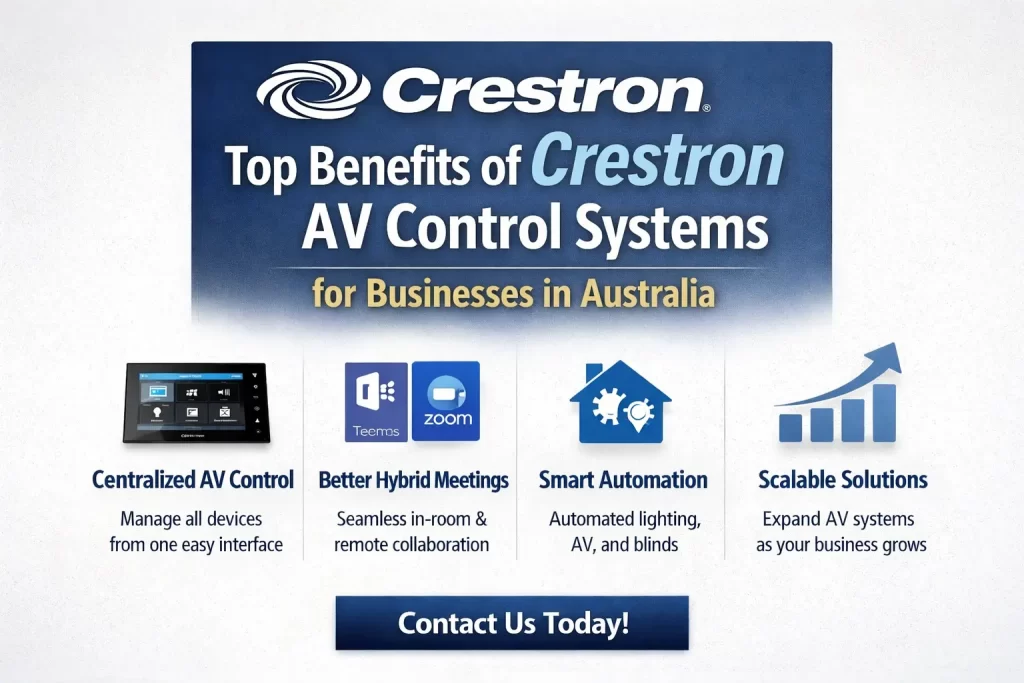
Crestron AV control systems benefits for businesses including centralized control, hybrid meetings, automation, and scalable AV solutions.

Across Australia, workplaces are adopting smarter technologies to improve collaboration, communication, and operational efficiency. Managing multiple audiovisual devices in meeting rooms, boardrooms, and large venues can become complex without a centralized system.

That’s where Crestron AV control systems make a difference.

We help businesses across Australia simplify technology by integrating audio, video, lighting, and conferencing tools into a single, easy-to-use platform. From corporate offices to universities and healthcare facilities, Crestron solutions allow us to create reliable, scalable, and intelligent AV environments.

Centralized AV Control for Modern Workplaces

One of the biggest advantages of Crestron AV control systems is centralized management. Instead of controlling multiple devices separately, we enable teams to manage everything through a single interface such as a touchscreen, tablet, or mobile device.

With Crestron, we can control:

  • Displays and projectors
  • Audio systems
  • Lighting and blinds
  • Video conferencing platforms
  • Room scheduling systems

This simplified control allows employees to start meetings quickly and use technology without technical complexity.

Better Hybrid Meetings and Collaboration

Hybrid work has become a standard model for many Australian organizations. Because of this, we design AV environments that support seamless collaboration between in-room and remote participants.

Crestron systems integrate smoothly with platforms like Microsoft Teams and Zoom.

With these integrations, we enable teams to:

  • Launch meetings instantly
  • Share content easily
  • Provide a consistent experience for remote participants
  • Improve communication across locations

This helps create professional meeting environments that support modern workplace collaboration.

Smart Automation for Office Efficiency

Another powerful feature of Crestron systems is intelligent automation. We design meeting spaces that respond automatically to schedules and occupancy sensors.

For example:

  • Displays power on when meetings begin
  • Lighting adjusts automatically
  • Video conferencing systems launch instantly
  • Motorized blinds adjust for optimal visibility

By automating these functions, we reduce setup time and make meetings more efficient.

Scalable AV Solutions for Growing Businesses

Whether we are supporting a single office or multiple locations across Australia, Crestron systems are designed to scale easily.

We can expand AV infrastructure by adding:

  • New meeting rooms
  • Training spaces
  • Collaboration hubs
  • Large conference environments

This flexibility allows us to build long-term AV solutions that grow with your business.

Remote Monitoring and System Management

We also implement remote monitoring capabilities that allow IT teams to manage AV systems across multiple locations.

With remote management, we can:

  • Monitor system performance
  • Troubleshoot issues remotely
  • Perform updates and maintenance
  • Reduce system downtime

This proactive management ensures that AV systems remain reliable and fully operational.

Customizable User Interfaces

Crestron systems offer customizable user interfaces designed specifically for each workplace environment.

We configure touchscreen panels with simple layouts so employees can easily operate meeting room technology with minimal training. This ensures meetings start on time and systems function smoothly every time.

Conclusion

Implementing Crestron AV control systems provides a smarter and more efficient way to manage workplace technology in Australia. By combining centralized control, automation, and seamless integration with collaboration platforms, we help businesses create productive and future-ready environments.

With the right AV control system in place, we can improve meeting efficiency, simplify technology management, and support the evolving needs of hybrid work.

Upgrade Your AV Systems with Expert Crestron Solutions

If you are looking to improve meeting room technology and workplace collaboration, we can help.

Our team designs and implements customized Crestron AV control systems that simplify operations and enhance productivity across Australian workplaces.

Contact us today to discuss your AV automation needs and build a smarter workplace with Crestron technology.


Top Benefits of Crestron AV Control Systems for Businesses in Australia Read More »

QSys AV Control for Healthcare Facilities

Healthcare facilities rely on technology every minute of every day. Doctors conduct virtual consultations, nurses receive emergency alerts, surgeons collaborate with specialists, and administrators manage meetings across multiple locations. Behind many of these interactions is an audiovisual (AV) infrastructure that needs to work flawlessly.

This is where Q-SYS AV Control for Healthcare Facilities becomes valuable. Rather than managing separate systems for displays, microphones, cameras, paging, room controls, and monitoring, healthcare organizations can bring them together on a single intelligent platform.

The result is better communication, easier management, and a more consistent experience for both staff and patients.

In this guide, we’ll explore how Q-SYS supports modern healthcare environments, where it delivers the most value, and why hospitals increasingly choose software-based AV control over traditional hardware-centric systems.

Why Healthcare Facilities Need Smarter AV Control

Hospitals are among the most technology-intensive buildings in the world. Clinical staff depend on accurate information, rapid communication, and systems that remain operational around the clock.

Unlike a standard office meeting room, healthcare environments include:

  • Patient rooms
  • Operating theatres
  • Telehealth suites
  • Nurse stations
  • Medical education classrooms
  • Conference rooms
  • Digital signage networks
  • Emergency operation centres

Each area often contains displays, microphones, speakers, cameras, and control devices from different manufacturers.

Managing every device independently quickly becomes complex.

A centralized AV control platform helps reduce this complexity while improving operational efficiency.

What Is Q-SYS?

Q-SYS is a software-based audio, video, and control platform developed by QSC. Instead of relying on multiple isolated hardware systems, it uses a unified architecture that integrates audio processing, video distribution, automation, monitoring, and device control.

Its cloud-ready architecture also allows authorized IT and AV teams to monitor systems remotely, helping reduce downtime and simplify maintenance.

According to QSC, the Q-SYS platform is built on standard IT technologies, making it easier to scale across facilities and integrate with enterprise networks.

Benefits of Q-SYS AV Control for Healthcare Facilities

Centralized System Management

Large hospitals may operate hundreds of AV-enabled spaces.

Instead of configuring each room separately, administrators can manage devices from one interface.

This simplifies:

  • Device monitoring
  • Firmware updates
  • Room configuration
  • Troubleshooting
  • Preventive maintenance

Centralized management also helps IT teams identify issues before users even notice them.

Better Telehealth Experiences

Telemedicine has become an essential healthcare service rather than a temporary solution.

Healthcare providers need reliable AV systems for:

  • Virtual consultations
  • Remote patient monitoring
  • Specialist collaboration
  • Mental health appointments
  • Follow-up visits

Q-SYS integrates professional audio, high-quality cameras, DSP processing, and conferencing platforms to deliver clearer communication.

When patients struggle to hear their doctor, everyone loses valuable time. Good AV control reduces these interruptions.

Improved Meeting and Collaboration Spaces

Healthcare organizations regularly conduct:

  • Clinical reviews
  • Administrative meetings
  • Medical training
  • Board meetings
  • Emergency planning sessions

Q-SYS supports integrated meeting environments where users can control:

  • Displays
  • Cameras
  • Microphones
  • Audio levels
  • Room automation

Everything can be managed through an intuitive touchscreen interface, reducing the need for complex user training.

Supporting Patient-Centered Care

Technology should never distract from patient care.

Instead, it should help healthcare professionals focus on patients rather than equipment.

Q-SYS contributes by enabling:

  • Easy room controls
  • Reliable communication
  • Faster access to information
  • Simplified presentation systems
  • Automated workflows

When technology works as expected, clinicians spend less time troubleshooting and more time caring for patients.

Digital Signage Across Healthcare Facilities

Hospitals rely heavily on digital signage to communicate important information.

Typical applications include:

  • Wayfinding
  • Department directories
  • Waiting room information
  • Health education
  • Emergency notifications
  • Visitor announcements

Q-SYS enables centralized content management across multiple displays while integrating with other building systems where appropriate.

This helps ensure consistent messaging throughout the facility.

Integration with Existing Healthcare Technology

One of the biggest strengths of Q-SYS is its ability to integrate with third-party technologies.

Healthcare environments often include equipment from multiple vendors.

Rather than replacing every device, organizations can integrate many existing systems into a unified control environment.

Common integrations include:

  • Microsoft Teams Rooms
  • Zoom Rooms
  • Network cameras
  • Digital signage platforms
  • Building management systems
  • Lighting controls
  • Environmental controls

This flexibility protects previous investments while supporting future expansion.

Remote Monitoring Improves System Reliability

Hospitals operate 24 hours a day.

Waiting until something breaks is rarely a good strategy.

Remote monitoring allows AV teams to:

  • Detect offline devices
  • Monitor equipment health
  • Receive alerts
  • Schedule maintenance
  • Reduce emergency service calls

Proactive monitoring minimizes downtime and helps maintain reliable communication systems throughout the hospital.

Security Matters in Healthcare AV Systems

Healthcare organizations place strong emphasis on cybersecurity because they handle sensitive information and critical operations.

While AV systems are different from electronic health record (EHR) systems, they still connect to enterprise networks and should follow organizational security practices.

Q-SYS supports modern IT deployment approaches such as:

  • User authentication
  • Role-based access
  • Secure network communication
  • Centralized administration

Healthcare organizations should also follow their own IT security policies and applicable regulations when deploying connected AV systems.

Scalability for Growing Healthcare Networks

Many healthcare providers operate:

  • Main hospitals
  • Community clinics
  • Diagnostic centres
  • Outpatient facilities
  • Administrative offices

A scalable AV platform makes expansion easier.

Instead of creating entirely new control systems for every location, organizations can standardize room designs and management processes across multiple facilities.

This consistency reduces training requirements and simplifies long-term maintenance.

Why Software-Based AV Control Makes Sense

Traditional AV systems often depend on dedicated hardware for every function.

Modern software-based platforms offer greater flexibility because updates can introduce new features without replacing physical equipment.

Benefits include:

  • Easier upgrades
  • Better scalability
  • Simplified integrations
  • Centralized management
  • Lower operational complexity

This software-first approach aligns well with how modern IT departments manage enterprise technology.

Best Practices for Deploying Q-SYS in Healthcare

Successful AV projects begin with careful planning rather than equipment selection.

Healthcare organizations should:

Assess User Requirements

Different departments have different communication needs.

Operating theatres, consultation rooms, classrooms, and boardrooms all require unique AV workflows.

Standardize Room Designs

Using consistent room layouts and user interfaces reduces confusion for staff and simplifies support.

Prioritize Network Readiness

Because Q-SYS operates over IP networks, proper network planning is essential for performance and reliability.

Organizations should work closely with both AV and IT teams during deployment.

Plan for Future Growth

Healthcare technology evolves rapidly.

Choosing scalable infrastructure helps accommodate future services, additional locations, and new collaboration platforms.

Choosing the Right Q-SYS Programmer

Even the best technology requires proper implementation.

An experienced Q-SYS programmer can:

  • Design intuitive user interfaces
  • Configure automation workflows
  • Integrate third-party systems
  • Optimize audio performance
  • Simplify room operation
  • Support future expansion

Healthcare facilities often have unique operational requirements, making experienced programming and commissioning especially important.

Conclusion

Healthcare professionals need technology they can trust without thinking about it. Whether supporting telehealth consultations, managing digital signage, or controlling meeting spaces, Q-SYS AV Control for Healthcare Facilities helps create reliable, scalable, and easy-to-manage AV environments.

Its software-based architecture, centralized management, and broad integration capabilities make it well suited for hospitals, clinics, medical education facilities, and healthcare networks looking to modernize their communication infrastructure.

When paired with thoughtful system design and an experienced Q-SYS programmer, healthcare organizations can build AV systems that improve collaboration, simplify operations, and support high-quality patient care for years to come.

Frequently Asked Questions

What is Q-SYS AV Control for Healthcare Facilities?

Q-SYS is a software-based audio, video, and control platform that enables healthcare organizations to centrally manage AV systems across patient rooms, telehealth spaces, meeting rooms, digital signage, and other clinical environments.

Can Q-SYS integrate with Microsoft Teams Rooms?

Yes. Q-SYS supports integration with platforms such as Microsoft Teams Rooms and Zoom Rooms, helping healthcare teams deliver consistent collaboration experiences across different meeting and telehealth spaces.

Why is centralized AV management important in hospitals?

Centralized management allows IT and AV teams to monitor devices, perform updates, troubleshoot issues remotely, and maintain consistent system performance across multiple rooms or facilities.

Does Q-SYS support remote monitoring?

Yes. Q-SYS provides remote monitoring capabilities that help administrators detect equipment issues early, receive alerts, and reduce downtime through proactive maintenance.

Why should healthcare organizations work with an experienced Q-SYS programmer?

An experienced Q-SYS programmer can design user-friendly control interfaces, integrate multiple technologies, automate workflows, and ensure the AV system aligns with the healthcare facility’s operational requirements.

QSys AV Control for Healthcare Facilities Read More »

How AV Monitoring Solutions Prevent Costly Downtime for Australian Businesses

In today’s fast-moving Australian business environment, technology drives everything. From corporate boardrooms and universities to healthcare facilities and government offices, AV systems are critical to daily operations.

When these systems fail, productivity stops.

At Zapperrav, we understand that AV downtime isn’t just a technical issue — it’s a business risk. That’s why we provide professional AV monitoring solutions designed to keep your systems running smoothly and prevent disruptions before they impact your organisation.

Why AV Downtime Is More Expensive Than You Think

Many businesses only think about AV support when something breaks. But by that point, the cost has already begun.

Downtime can result in:

  • Cancelled client meetings
  • Disrupted hybrid conferences
  • Lost productivity
  • Emergency repair expenses
  • Damage to brand reputation

Instead of reacting to failures, we focus on proactive AV maintenance to prevent them from happening in the first place.

What Are AV Monitoring Solutions?

Our AV monitoring solutions provide continuous, real-time oversight of your audiovisual systems. We remotely track the health and performance of:

  • Displays and projectors
  • Audio processors and amplifiers
  • AV control systems
  • Video conferencing equipment
  • Network connectivity
  • Power status and device temperature

By monitoring system performance 24/7, we identify potential issues early — often before users even notice a problem.

This proactive approach keeps your business running without interruption.

How Remote AV Support Makes the Difference

One of the biggest advantages of modern AV infrastructure is the ability to provide remote AV support.

When an issue arises, we can:

  • Access systems remotely
  • Diagnose faults in real time
  • Restart or reconfigure devices
  • Apply firmware updates
  • Resolve many problems without an on-site visit

For organisations with multiple offices across Australia, remote AV support dramatically reduces response times and eliminates unnecessary travel delays.

The result? Faster resolutions and minimal disruption.

The Power of Proactive AV Maintenance

Traditional AV support is reactive — something breaks, then it gets fixed.

We believe that approach is outdated.

With proactive AV maintenance, we continuously analyse system performance data to detect early warning signs such as:

  • Overheating equipment
  • Signal instability
  • Failing components
  • Network communication errors

By addressing minor issues early, we prevent major failures, reduce emergency call-outs, and extend the lifespan of your AV investment.

Proactive maintenance not only lowers costs — it improves reliability and user confidence in your technology.

Why Australian Businesses Trust Proactive Monitoring

Hybrid work environments and digital collaboration tools have made AV systems mission-critical.

We work with Australian businesses that rely on seamless communication across:

  • Corporate offices
  • Education institutions
  • Healthcare environments
  • Government facilities
  • Commercial venues

For these organisations, reliable AV performance isn’t optional — it’s essential.

Our AV monitoring solutions, combined with expert remote AV support and structured proactive AV maintenance, provide peace of mind that systems will perform when they are needed most.

Frequently Asked Questions

1. What are AV monitoring solutions?

AV monitoring solutions are systems that continuously track the health and performance of audiovisual equipment to detect and resolve issues before they cause downtime.

2. How does remote AV support reduce downtime?

Remote AV support allows technicians to access and fix systems without waiting for an on-site visit, significantly reducing response time and business disruption.

3. What is proactive AV maintenance?

Proactive AV maintenance involves monitoring system performance, identifying early warning signs, and resolving potential issues before equipment fails.

4. Is AV monitoring suitable for multi-site organisations?

Yes. AV monitoring solutions are especially valuable for businesses operating across multiple Australian locations, providing centralised oversight and faster issue management.

5. How much can businesses save with proactive monitoring?

While savings vary, businesses typically reduce emergency repair costs, avoid productivity losses, and extend equipment lifespan — leading to substantial long-term cost benefits.

🚀 Protect Your Business with Smarter AV Support

At Zapperrav, we don’t wait for systems to fail.

We provide intelligent AV monitoring solutions, fast remote AV support, and structured proactive AV maintenance to keep your business operating without interruption.

If your organisation depends on reliable AV systems, it’s time to move from reactive fixes to proactive protection.

👉 Book a consultation with our team today and discover how we can:

  • Reduce AV downtime
  • Improve system reliability
  • Lower long-term maintenance costs
  • Ensure seamless business operations

Let’s future-proof your AV systems — before problems arise.

How AV Monitoring Solutions Prevent Costly Downtime for Australian Businesses Read More »

AV System Integration for Healthcare Facilities: Connecting Technology to Improve Patient Care

Healthcare facilities today are more connected than ever before. Hospitals, medical centres, specialist clinics, and aged care facilities rely on technology not only for treatment — but for communication, collaboration, education, and patient engagement.

This is where healthcare AV integration becomes essential.

Modern audiovisual systems are no longer standalone tools like a screen in a waiting room or a speaker in a conference space. Instead, they form a fully integrated ecosystem that connects departments, supports telehealth, improves training, and enhances patient experiences — all while maintaining strict reliability and security standards.

In a healthcare environment, seamless communication can directly impact patient outcomes. That’s why integrated AV systems are becoming a strategic investment rather than just a technical upgrade.

What Is Healthcare AV Integration?

Healthcare AV integration is the process of designing and connecting audiovisual technologies so they work together smoothly across an entire medical facility.

This can include:

  • Video conferencing systems for telehealth
  • Digital signage for wayfinding and announcements
  • Interactive displays in training rooms
  • Audio and paging systems for urgent communication
  • Control systems that manage all AV devices centrally

Instead of managing separate devices independently, integrated systems allow healthcare providers to operate everything from a unified platform. The result is better communication, reduced technical issues, and improved operational efficiency.

Why AV Integration Is Critical in Modern Healthcare

1. Supporting Telehealth and Remote Consultations

Telehealth has become a permanent part of healthcare delivery. Integrated AV systems ensure virtual consultations run smoothly with high-definition video, crystal-clear audio, and secure connectivity.

For patients in rural or remote areas, this means greater access to specialists without long travel times. For hospitals, it enables collaboration between doctors across different locations.

Reliable healthcare AV integration ensures consultations feel professional, personal, and interruption-free.

2. Enhancing Communication Between Medical Teams

Hospitals operate in fast-paced environments where every second counts. Clear communication between departments is critical.

Integrated AV solutions support:

  • Interdisciplinary video meetings
  • Case review discussions
  • Emergency paging systems
  • Secure internal broadcasts

By connecting communication tools across departments, staff can collaborate faster and make informed decisions more efficiently.

3. Improving the Patient Experience

Visiting a hospital can be stressful. Integrated AV systems help create a more supportive and informative environment for patients and visitors.

Digital signage can:

  • Provide clear wayfinding directions
  • Display appointment schedules
  • Share health education content
  • Deliver emergency alerts

Interactive displays in waiting areas can offer useful information or calming content, helping reduce anxiety and improve overall satisfaction.

In patient rooms, integrated entertainment and communication systems allow individuals to stay connected with family members and access helpful recovery information.

4. Supporting Medical Training and Education

Healthcare is a field that depends on continuous learning. AV integration plays a major role in training environments such as lecture theatres, simulation labs, and surgical observation rooms.

Integrated systems allow:

  • Live streaming of procedures
  • Recording for later review
  • Hybrid training sessions
  • Interactive classroom learning

These tools enhance knowledge sharing and allow medical professionals to develop skills in more flexible and effective ways.

5. Boosting Operational Efficiency

Healthcare facilities operate 24/7, and technology downtime is not an option.

Integrated AV systems allow IT teams to:

  • Monitor equipment remotely
  • Manage multiple systems from a central interface
  • Reduce duplication of devices
  • Streamline maintenance processes

This improves reliability while lowering long-term operational costs. Instead of troubleshooting isolated systems, staff can manage a connected infrastructure designed for performance and scalability.

Key Features of Effective Healthcare AV Integration

Because healthcare environments are highly sensitive, AV systems must meet specific requirements:

✔ Secure network integration
✔ High-definition video and clear audio
✔ Centralised control systems
✔ Scalable, future-ready infrastructure
✔ Minimal downtime during installation
✔ Ongoing support and maintenance

Every system must prioritise privacy, compliance, and consistent reliability.

Common Challenges in Healthcare AV Projects

Healthcare facilities present unique technical challenges, including:

  • Strict data privacy and security regulations
  • Complex existing IT networks
  • Infection control requirements
  • Continuous operations with limited downtime

Careful planning and professional integration ensure systems are implemented without disrupting patient care or daily operations.

The Future of Healthcare AV Integration

As healthcare continues to embrace digital transformation, AV integration will become even more advanced. Future-ready facilities are already adopting:

  • AI-supported telemedicine rooms
  • Smart patient monitoring dashboards
  • Fully networked training centres
  • Advanced video collaboration spaces

IP-based AV infrastructure will continue to support connected care models, remote expertise, and data-driven decision-making.

Final Thoughts

Healthcare AV integration is about much more than screens and speakers. It is about building a connected environment where communication is clear, collaboration is seamless, and patient care is enhanced.

From telehealth rooms to surgical theatres, from digital signage to staff collaboration spaces, integrated AV systems help healthcare facilities operate more efficiently while improving the experience for both patients and medical professionals.

In today’s healthcare landscape, a well-designed AV integration strategy isn’t optional — it’s essential for delivering safe, effective, and future-ready care.

AV System Integration for Healthcare Facilities: Connecting Technology to Improve Patient Care Read More »

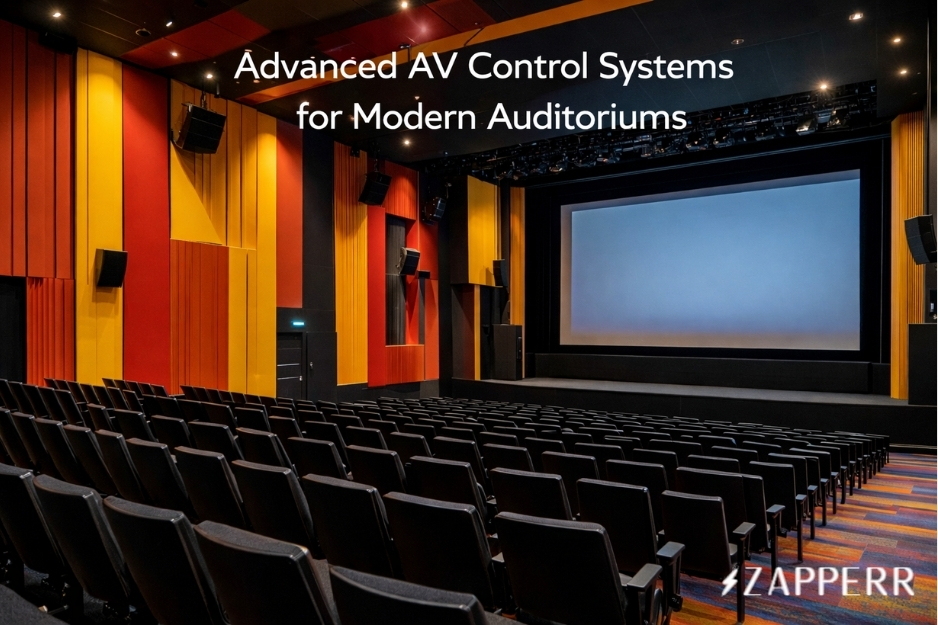
Extron Programming for Auditoriums & Conference Centers Advanced Auditorium AV Control Systems for Large Venues

Modern auditoriums and conference centers demand more than basic audio-visual setups. From international summits and corporate conventions to university graduations and live performances, large venues require powerful, reliable, and easy-to-manage AV systems. This is where Extron large venue programming delivers exceptional performance.

Powered by Extron, advanced control systems ensure seamless integration of audio, video, lighting, and presentation technologies into one centralized auditorium AV control system.

Why Auditoriums Need Professional AV Control Systems

Large venues typically include:

  • Multiple projection screens or LED walls
  • High-powered sound systems
  • Wireless and wired microphones
  • Stage lighting control
  • Video conferencing integration
  • Recording and streaming systems
  • Digital signage displays

Without a centralized control system, managing these technologies becomes complex and inefficient. Extron programming simplifies operations with intuitive touch panel control and automated workflows.

What Is Extron Large Venue Programming?

Extron programming involves configuring control processors, user interfaces, and automation logic to ensure all AV components work together flawlessly.

Using platforms like Extron Global Configurator and Extron Control Script, AV professionals create customized control environments that allow venue operators to:

  • Switch video sources instantly
  • Control audio levels across zones
  • Manage lighting presets
  • Automate event setups
  • Monitor system performance

This eliminates the need for multiple remotes or manual device control.

Key Benefits of Extron Programming for Auditoriums

1️⃣ Centralized AV Control

Operators can manage the entire venue from a single touch interface. Whether it’s switching from a keynote presentation to a live video feed or adjusting microphone levels mid-event, everything is controlled seamlessly.

2️⃣ Automated Event Modes

Custom programming allows preset modes such as:

  • Conference Mode
  • Presentation Mode
  • Live Performance Mode
  • Video Streaming Mode
  • Recording Mode

With one touch, the entire system adjusts automatically.

3️⃣ Scalable for Large Conference Centers

Conference centers often contain:

  • Multiple breakout rooms
  • Main auditoriums
  • Lobby display areas
  • Press rooms

Extron large venue programming enables centralized control across multiple spaces, improving efficiency and reducing technical staffing requirements.

4️⃣ Integration with Video Conferencing Platforms

Modern conference venues frequently integrate with platforms like Microsoft Teams and Zoom for hybrid events.

Extron control systems allow:

  • Seamless switching between in-person and remote presenters
  • Audio routing for virtual participants
  • Camera control and automation
  • Streamlined hybrid meeting workflows

This ensures smooth event experiences without technical disruptions.

Advanced Audio & Video Management

In large auditoriums, audio clarity is critical. Extron programming enables:

  • Multi-zone audio control
  • DSP integration
  • Echo cancellation for conferencing
  • Balanced microphone mixing

For video, systems can manage:

  • Matrix switching
  • Multi-screen output
  • Live streaming feeds
  • Recording workflows
  • Digital signage displays

The result is a powerful and reliable auditorium AV control system tailored to each venue’s needs.

Why Choose Extron for Large Venue Automation?

✔ Enterprise-grade reliability
✔ Secure networked AV architecture
✔ Flexible programming options
✔ Scalable infrastructure
✔ User-friendly touch panels
✔ Remote monitoring capabilities

Extron systems are widely trusted in government facilities, universities, corporate headquarters, and convention centers worldwide.

Future-Proofing Your Auditorium AV System

As events become more hybrid and technology-driven, venues must adapt to:

  • 4K/8K video distribution
  • AV over IP systems
  • Remote event management
  • AI-powered camera tracking
  • Cloud-based monitoring

Professional Extron programming ensures your venue is ready for future technological advancements without major infrastructure changes.

Conclusion

A modern auditorium or conference center cannot rely on disconnected AV components. It requires a fully integrated, scalable, and intelligent auditorium AV control system.

Extron large venue programming provides the performance, flexibility, and reliability needed to deliver flawless events every time. From automated event modes to hybrid conferencing integration, Extron empowers venue operators with complete control at their fingertips.

If you’re planning to upgrade or design a new large venue AV system, investing in professional Extron programming ensures operational efficiency, superior audience experience, and long-term reliability.

Upgrade Your Auditorium AV Control System Today

Planning a new auditorium or upgrading your conference center AV system?

Our certified Extron programming specialists design and deploy fully integrated large venue control systems tailored for performance, reliability, and scalability.

We provide:

✔ Custom Extron large venue programming
✔ Centralized auditorium AV control systems
✔ Hybrid event & conferencing integration
✔ Multi-room and breakout room automation
✔ Ongoing maintenance & remote support

Whether you manage a university auditorium, corporate conference center, government facility, or convention venue, we deliver solutions that ensure flawless event execution every time.

Book a consultation today and discover how Extron programming can transform your large venue AV operations.

📞 Speak with an AV automation expert
📩 Request a customized proposal


Extron Programming for Auditoriums & Conference Centers Advanced Auditorium AV Control Systems for Large Venues Read More »

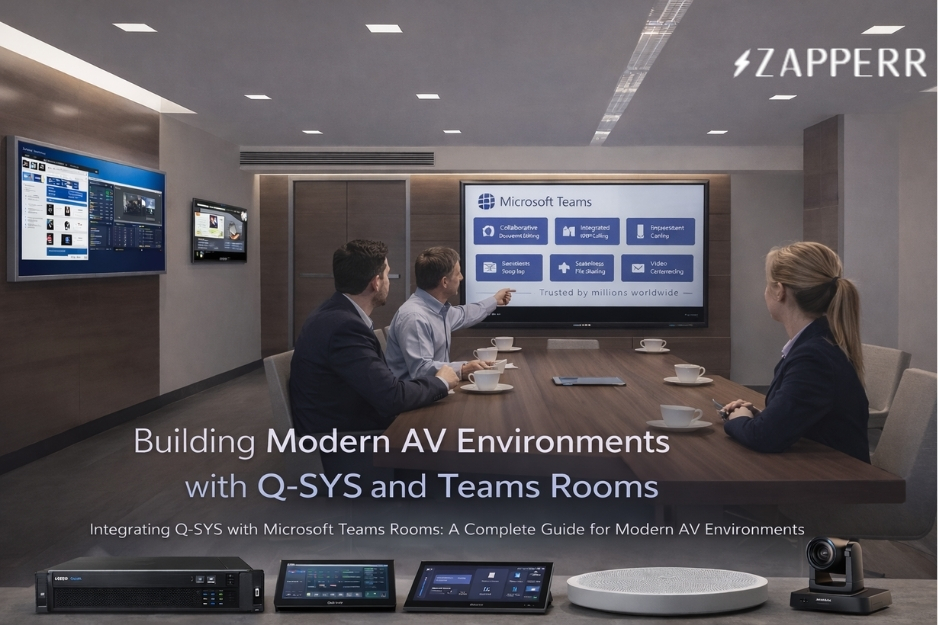
Integrating QSys with Microsoft Teams Rooms: A Complete Guide for Modern AV Environments

Hybrid work has transformed how businesses communicate. Employees now expect meetings to start instantly, audio to be crystal clear, and remote participants to enjoy the same experience as those in the room. Unfortunately, many organizations still struggle with poor audio quality, complicated room controls, and unreliable meeting technology.

This is where integrating Q-SYS with Microsoft Teams Rooms (MTR) makes a significant difference. Microsoft Teams Rooms provides a familiar collaboration platform, while Q-SYS adds intelligent audio processing, advanced room control, automation, and centralized management.

When properly designed, this integration creates meeting spaces that are easier to use, simpler to manage, and ready to scale as business needs grow.

In this guide, you’ll learn how Q-SYS works with Microsoft Teams Rooms, the benefits of integration, deployment best practices, common mistakes to avoid, and expert recommendations based on real-world AV projects.

What Is Q-SYS?

Q-SYS is a software-based audio, video, and control platform developed for modern commercial AV environments. Instead of relying on multiple standalone processors, Q-SYS combines audio processing, video routing, automation, monitoring, and room control into a single ecosystem.

Organizations commonly use Q-SYS in:

  • Corporate meeting rooms
  • Boardrooms
  • Universities
  • Healthcare facilities
  • Government buildings
  • Hotels
  • Training centres
  • Auditoriums

Its flexibility makes it suitable for both small meeting spaces and enterprise-wide AV deployments.

What Are Microsoft Teams Rooms?

Microsoft Teams Rooms are dedicated meeting room systems designed specifically for Microsoft Teams. They provide a consistent meeting experience using certified hardware such as touch controllers, cameras, microphones, speakers, and displays.

Instead of relying on individual laptops, users simply enter the room, tap Join, and begin collaborating.

Typical components include:

  • Teams Room Compute Device
  • Touch Panel Controller
  • Teams-certified Camera
  • Display Screens
  • Microphones
  • Speakers

Microsoft Teams Rooms simplify the meeting experience while reducing user errors.

Why Integrate Q-SYS with Microsoft Teams Rooms?

Although Microsoft Teams Rooms provide an excellent collaboration platform, many businesses require more advanced AV capabilities.

Q-SYS enhances Teams Rooms by delivering:

  • Professional digital signal processing (DSP)
  • Intelligent room automation
  • Better microphone management
  • Flexible camera control
  • Centralized monitoring
  • Enterprise scalability

The result is a more reliable and professional meeting experience for both in-room and remote participants.

For organizations with custom meeting room requirements, working with an experienced Q-SYS programmer ensures the integration is configured to match specific workflows, room layouts, and automation needs. Professional programming helps optimize system performance while reducing future troubleshooting and maintenance. 

How the Integration Works

In most deployments:

  • Microsoft Teams Rooms manages video conferencing and scheduling.
  • Q-SYS controls microphones, speakers, cameras, displays, and automation.
  • The systems communicate through USB or network-based integration.

This approach combines the simplicity of Teams with the flexibility of an enterprise AV platform.

Key Benefits of Q-SYS and Microsoft Teams Rooms Integration

Superior Audio Quality

Poor audio is one of the main reasons meetings become frustrating. Q-SYS includes powerful DSP features that improve voice clarity and reduce distractions.

These include:

  • Acoustic Echo Cancellation
  • Automatic Gain Control
  • Noise Reduction
  • Feedback Suppression
  • Automatic Microphone Mixing

The result is clear communication regardless of room size.

Intelligent Meeting Room Automation

Automation improves both user experience and operational efficiency.

Examples include:

  • Automatically turning displays on when meetings begin
  • Switching cameras based on room configuration
  • Controlling lighting and blinds
  • Powering equipment down after meetings
  • Activating occupancy-based automation

Users spend less time troubleshooting technology and more time collaborating.

Enterprise Scalability

Whether managing five meeting rooms or five hundred, Q-SYS provides centralized management that simplifies deployment, monitoring, and maintenance.

This makes it an excellent long-term investment for growing organizations.

Choosing the Right Integration Method

Integration Method

Best For

Advantages

Considerations

USB Integration

Small and medium meeting rooms

Easy deployment, lower cost, reliable

Limited advanced automation

Network Integration

Enterprise environments

Advanced control, monitoring, scalability

Requires experienced AV programming

Expert Tip: USB integration is often the best choice for standard meeting rooms. Network integration delivers greater flexibility but should only be implemented when advanced functionality is genuinely required.

Essential Hardware Components

A professional deployment typically includes:

  • Q-SYS Core Processor
  • Microsoft Teams Room Compute
  • Touch Controller
  • PTZ Camera
  • Ceiling or Table Microphones
  • DSP Processor
  • Amplifier
  • Display Screens
  • Network Switch
  • Speakers

Selecting certified hardware helps ensure compatibility and long-term reliability.

Best Practices for a Successful Deployment

Design Around the Room, Not the Equipment

Every room has unique acoustic and physical characteristics.

Consider:

  • Ceiling height
  • Room dimensions
  • Glass surfaces
  • Background noise
  • Seating arrangement
  • Display placement

A thoughtfully designed room often outperforms one filled with expensive equipment but poor planning.

Optimize Your Network

Many AV issues are actually network issues.

Best practices include:

  • Configure Quality of Service (QoS)
  • Use enterprise-grade switches
  • Keep firmware updated
  • Assign static IP addresses where appropriate
  • Ensure sufficient bandwidth for conferencing traffic

Reliable networking is essential for consistent meeting performance.

Test Real Meeting Scenarios

Before deployment, test:

  • Remote participants
  • Multiple presenters
  • Screen sharing
  • Camera switching
  • Audio clarity
  • Recovery after power interruptions

Comprehensive testing helps identify issues before users encounter them.

Common Integration Challenges

Problem

Likely Cause

Recommended Solution

Audio echo

Incorrect microphone placement

Reposition microphones and fine-tune DSP settings

Camera not detected

USB communication issue

Check cabling, firmware, and device configuration

Delayed audio

Network congestion

Review QoS settings and network utilization

Device offline

IP conflict

Assign static addresses and verify switch configuration

Room automation failure

Programming logic error

Review control scripts and automation workflows

Hidden Network Mistakes That Cause Most Integration Problems

Many organizations assume AV hardware is responsible for poor meeting experiences. In reality, networking is often the root cause.

Experienced AV integrators regularly encounter issues such as:

  • Improper VLAN configuration preventing device discovery
  • Multicast traffic blocking Q-SYS communication
  • Poor QoS settings affecting audio performance
  • Shared office Wi-Fi causing unstable connections
  • Firewall rules interrupting device communication

Investing in network planning before installation reduces long-term support costs.

Myth vs Reality

Myth

Reality

Every Teams Room needs advanced Q-SYS automation.

Many smaller meeting rooms perform perfectly with simple USB integration.

More microphones automatically improve audio.

Incorrect placement often reduces clarity and increases echo.

Expensive AV hardware guarantees better meetings.

Room design and system programming have a greater impact.

Once installed, the system requires no maintenance.

Firmware updates, monitoring, and preventive maintenance remain essential.

AV problems are usually hardware failures.

Most recurring issues originate from network configuration or system design.

Advanced Insight: Scaling Q-SYS Across Multiple Office Locations

Managing a single meeting room is relatively straightforward. Managing dozens or hundreds introduces new operational challenges.

Successful enterprise deployments typically focus on:

  • Standardized programming templates
  • Centralized monitoring
  • Consistent firmware management
  • Preventive maintenance schedules
  • Documentation for every room
  • Remote troubleshooting capabilities

Standardization reduces support costs and improves user consistency across all locations.

Why Some Q-SYS Projects Fail

Not every AV integration delivers the expected results.

Common reasons include:

  • Poor room acoustic planning
  • Selecting hardware before understanding business requirements
  • Lack of user training
  • Ignoring future scalability
  • Inadequate documentation
  • No preventive maintenance strategy

The most successful projects begin with understanding how employees actually use meeting spaces rather than focusing solely on technology.

Why Work with an Experienced Q-SYS Programmer?

An experienced Q-SYS programmer plays a critical role in delivering reliable and scalable AV solutions. Beyond configuring the system, they design custom control logic, optimize digital signal processing (DSP), and ensure Microsoft Teams Rooms integrate seamlessly with displays, cameras, microphones, and third-party devices. This expertise helps create meeting spaces that are easier to manage and adapt as business requirements evolve.

Frequently Asked Questions

Does Q-SYS replace Microsoft Teams Rooms?

No. Teams Rooms manages meetings, while Q-SYS enhances audio, control, automation, and room management.

Which integration method is better?

USB integration is ideal for many standard meeting rooms. Larger enterprise environments often benefit from network-based integration.

Can Q-SYS manage multiple meeting rooms?

Yes. It supports centralized monitoring and management across multiple locations.

Is professional programming necessary?

For advanced automation, enterprise deployments, and custom workflows, professional programming is highly recommended.

How often should AV systems be maintained?

Preventive maintenance, firmware updates, and system health checks should be performed regularly to ensure long-term reliability.

Can Q-SYS integrate with other conferencing platforms?

Yes. Depending on the deployment, Q-SYS can also support platforms such as Zoom Rooms, Cisco Webex, and Google Meet.

Conclusion

If your organization is planning to upgrade existing meeting rooms or deploy Microsoft Teams Rooms across multiple locations, partnering with an experienced Q-SYS programmer and AV integration specialist can help you design a reliable, scalable, and future-ready solution. From system design and programming to installation, testing, and ongoing support, the right expertise ensures your meeting spaces continue to perform efficiently as your business grows.

Integrating QSys with Microsoft Teams Rooms: A Complete Guide for Modern AV Environments Read More »

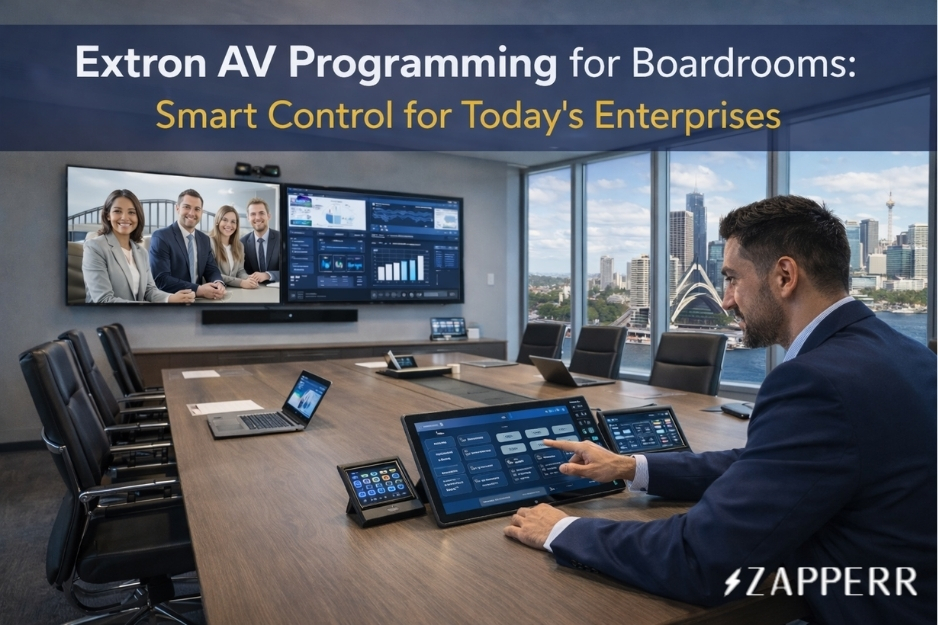
Extron Programming for Corporate Boardrooms: Smarter Control for Modern Enterprises

Extron Programming for Corporate Boardrooms: Smarter Control for Modern Enterprises

Modern corporate boardrooms demand technology that is powerful, intuitive, and completely reliable. That’s why we focus on delivering Extron Programming for Corporate Boardrooms that transforms complex AV systems into seamless, intelligent, and easy-to-use environments. With professional Extron programming, we create boardroom solutions that are scalable, secure, and designed to support today’s collaborative workplace.

Why Extron Programming for Corporate Boardrooms Matters

We often see corporate boardrooms filled with advanced displays, conferencing systems, microphones, wireless presentation tools, and lighting controls. However, without proper integration, these systems can become difficult to manage.

Through Extron Programming for Corporate Boardrooms, we unify all AV components into a single, centralised control system. This allows us to deliver:

  • Simplified user control
  • Faster meeting start times
  • Reduced technical disruptions
  • Consistent system performance

Instead of juggling multiple remotes or switching inputs manually, we ensure your entire boardroom operates from one intuitive interface.

Centralised Control with Extron Control Systems

When we design Extron control systems, our goal is to make technology invisible. We program each component to work together seamlessly, creating efficient and reliable corporate boardroom AV solutions.

With professional Extron programming, we enable you to:

  • Power displays and projectors with one touch
  • Switch presentation sources instantly
  • Adjust audio levels automatically
  • Launch video conferencing sessions effortlessly
  • Activate pre-set room configurations

This level of boardroom AV automation eliminates confusion and enhances productivity across your organisation.

Seamless Hybrid Meeting Integration

Hybrid meetings are now a standard requirement in corporate environments. We ensure your boardroom integrates smoothly with collaboration platforms such as Microsoft Teams and Zoom.

With our Extron Programming for Corporate Boardrooms, we configure systems to:

  • Automatically launch video conferencing
  • Adjust camera presets based on meeting type
  • Optimise audio for remote participants
  • Configure displays for content sharing

By automating these processes, we create a professional, distraction-free meeting experience for both in-room and remote participants.

Faster Meeting Start Times Through Automation

We know that delays in executive meetings cost time and money. That’s why we implement intelligent automation presets tailored to your workflow.

For example, we can program:

  • Presentation Mode

    – Configures displays and audio for internal meetings
  • Video Conference Mode

    – Activates cameras, microphones, and conferencing software
  • Executive Mode

    – Adjusts lighting and display settings for high-level discussions

With customised Extron programming, your boardroom is always prepared, ensuring meetings start on time without technical issues.

Scalable Corporate Boardroom AV Solutions

As your organisation grows, your technology should grow with it. We design Extron Programming for Corporate Boardrooms with scalability in mind.

Whether you need:

  • A single executive boardroom solution
  • Multiple conference room integrations
  • Campus-wide AV standardisation
  • Multi-location enterprise deployments

We ensure your AV infrastructure remains consistent, reliable, and easy to manage across all spaces.

Enterprise-Level Security and Reliability

Security is critical in corporate boardrooms where sensitive discussions take place. We program Extron systems with secure network configurations and structured logic to protect your infrastructure.

By implementing professionally designed Extron control systems, we help you achieve:

  • Secure device communication
  • Reliable AV-over-IP distribution
  • Reduced downtime
  • Long-term system stability

This proactive approach reduces IT support calls and safeguards your business communications.

Why We Recommend Professional AV Programming Services

Installing AV equipment is only part of the solution. The real value lies in how the system is programmed and integrated.

When we deliver professional AV programming services, we ensure:

✔ Simplified User Experience

We design clean, customised touch panel interfaces that are easy for executives and staff to operate.

✔ Reduced Operational Costs

Well-programmed systems require less troubleshooting and ongoing maintenance.

✔ Future-Ready Performance

Our structured programming allows for updates, upgrades, and expansion without starting from scratch.

✔ Increased Productivity

When technology works seamlessly, your teams can focus on strategy and collaboration.

Let’s Transform Your Corporate Boardroom

If your boardroom technology feels complicated or unreliable, we’re here to help. At Zapperr, we provide expert Extron Programming for Corporate Boardrooms designed to enhance performance, automation, and usability.

We specialise in:

  • Custom Extron control system programming
  • Boardroom AV automation
  • Hybrid meeting integration
  • Enterprise AV system design
  • Ongoing support and optimisation

👉 Book a consultation with us today and discover how we can transform your corporate boardroom into a seamless, high-performance collaboration space.


Extron Programming for Corporate Boardrooms: Smarter Control for Modern Enterprises Read More »

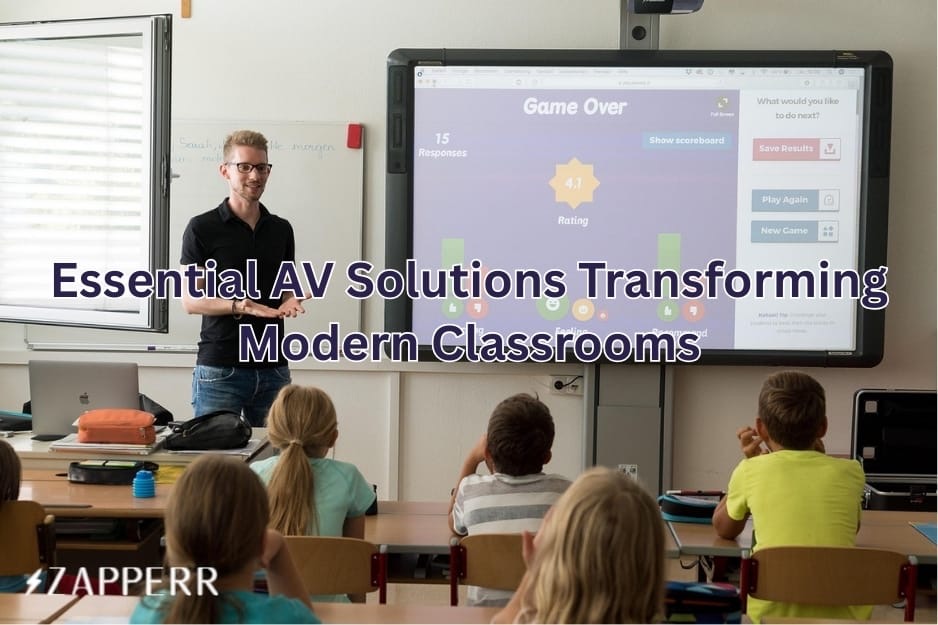
Top AV Solutions Every School Needs in 2026

Across Australia, schools, TAFEs, and universities are rapidly transforming their learning environments. From major cities to regional campuses, technology is playing a bigger role in how educators teach and how students engage with content. Classrooms are no longer limited to traditional tools and static presentations.

Top AV Solutions Every School Needs in 2026 are now essential for delivering interactive, inclusive, and future-ready education experiences. At Zapper AV, we help institutions implement reliable audiovisual systems that make teaching simpler while improving student outcomes.

In 2026, AV solutions go far beyond projectors and speakers. The right setup supports hybrid learning, boosts engagement, empowers teachers, and ensures schools are prepared for evolving educational demands. Here’s a practical guide to the key AV solutions every Australian school should consider this year.

1. Interactive Displays & Smart Panels

Interactive displays have become the centrepiece of modern classrooms.

Unlike traditional whiteboards, today’s smart panels allow teachers to annotate lessons in real time, integrate multimedia content, and wirelessly share screens from student devices.

These tools make lessons more engaging and collaborative, encouraging participation and active learning across all education levels.

2. Reliable Audio Systems for Clear Communication

Clear audio is just as important as clear visuals.

High-quality classroom audio systems ensure that every student — from the front row to the back — can hear comfortably without teachers raising their voice.

A complete classroom audio solution may include:

  • Ceiling or wall-mounted speakers
  • Wireless microphones for teachers
  • Assistive listening devices for students with hearing needs

Strong audio systems improve clarity, reduce teacher fatigue, and promote inclusive learning environments.

3. Lecture Capture & Hybrid Learning Tools

Hybrid learning is now part of everyday education in Australia.

Lecture capture and streaming systems allow schools to record and share lessons, giving students access whether they’re in the classroom, learning remotely, or reviewing content later.

These systems can:

  • Record and archive lessons
  • Support real-time video conferencing
  • Enable flexible, asynchronous learning

This flexibility ensures that learning remains accessible and adaptable.

4. Simple Control & Collaboration Systems

Technology should simplify the teaching experience.

Modern AV control systems allow educators to manage displays, audio, and presentation tools from a single touch interface. This reduces technical disruptions and keeps lessons running smoothly.

Wireless collaboration tools also enable seamless content sharing from laptops, tablets, and smartphones — eliminating cable clutter and technical barriers.

5. AV Integration for Lecture Theatres & Auditoriums

Large learning spaces require specialised AV integration.

Lecture halls and auditoriums benefit from high-resolution displays, robust sound systems, and scalable video distribution to ensure clarity for both in-person and online audiences.

Well-designed AV integration also supports campus events, guest speakers, and community activities, maximising the value of these spaces.

6. Digital Signage & Campus Communications

Digital signage is becoming increasingly important across Australian campuses.

These systems can:

  • Display announcements and updates
  • Share timetables and event information
  • Provide wayfinding in large facilities
  • Deliver emergency notifications

Digital signage enhances communication and keeps the entire campus community informed.

7. Seamless Networked & Hybrid Infrastructure

Behind every effective AV system is strong network integration.

Modern educational institutions require scalable, IP-based infrastructure that is secure, manageable, and ready for future expansion.

Networked AV systems allow IT teams to monitor performance remotely, support hybrid classrooms, and maintain consistent reliability across campus.

8. Accessibility & Inclusive Learning Technology

Inclusive education requires technology that supports every learner.

Assistive listening systems, captioning features, and evenly distributed audio help ensure all students can fully participate in classroom activities.

These accessibility solutions align with Australia’s commitment to inclusive education and create supportive learning environments for everyone.

What Makes a Great AV Solution in 2026?

A high-performing AV system should be:

✔ Easy for teachers to use
✔ Flexible and future-ready
✔ Compatible with existing tools
✔ Supportive of both in-person and remote learning
✔ Reliable with ongoing support

At Zapper AV, we design tailored AV solutions that genuinely enhance teaching and learning — whether for a single classroom or an entire campus.

Education Technology Is a Learning Enabler

In 2026, AV systems are no longer optional extras. They are central to delivering meaningful, engaging, and seamless educational experiences.

If you’re planning to upgrade a classroom or implement a campus-wide AV strategy, the right solution should empower educators and simplify learning.

👉 Talk to our team today to explore customised AV solutions for your school or institution.


Top AV Solutions Every School Needs in 2026 Read More »

Scroll to Top